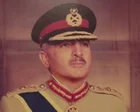
Waheed Kakar, who has died aged 89, held the top post in the Pakistan army from 1993 until 1996, and he is remembered for something rare in a country with a long history of military rulers: he declined to seize power when he had the chance. In July 1993, faced with a standoff between the prime minister, Nawaz Sharif, and the president, Ghulam Ishaq Khan, he secured the resignation of both civilian leaders and allowed elections to be held. That choice is recorded as the "Kakar formula", and it deserves more than a respectful footnote.
The circumstances of his rise make his restraint more striking. After the sudden death of Gen Asif Nawaz Janjua in January 1993, the selection of a successor deadlocked because Sharif and Khan each had their own favourite. Kakar, the fifth general in line for the post, was chosen because he had no connections to either man. A leader who owes his position to being nobody's man has every reason to be cautious about rewriting the rules. He used the authority he was given to hand the decision back to voters.
His refusal to stay on in 1996 is equally instructive. Benazir Bhutto, who came to power in the elections that followed, sent repeated offers, direct and indirect, for him to continue as chief. He said, "I am going home." Bhutto later called him "a totally non-interfering army chief" and "an honourable man". Those words should not be treated as a eulogy alone. They describe the minimum that a democracy should expect from its military, and they show how seldom that minimum has been met.
Kakar's record was not spotless, and a fair reading acknowledges that. He forced the retirement of two powerful generals, one accused of interfering in politics and one alleged to have supported extremists, and the 1995 plot by at least 38 officers to assassinate senior leaders and impose a coup shows how dangerous the institution's internal fault lines could be. Still, his advice that religion be kept out of the army, as reported by Mariana Babar, is a principle Pakistan has not consistently honoured. The lesson for today's leaders is that restraint is a choice that can be made, and that it is worth remembering.