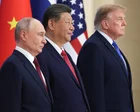
The first meeting of the leaders of China, Russia and the United States was historic in the narrow sense that it had never happened before. Beyond that, the Shenzen gathering produced little that matters. Vladimir Putin claimed it had written a "new page in the history of diplomacy", but the trio's brief joint statement offers no page worth remembering. It covered energy supply, United Nations reform, limits on the International Criminal Court and a tentative commitment to discuss nuclear disarmament and non-proliferation. Four loosely related topics, none with a plan attached, do not amount to a new order.
The contrast with Yalta in 1945 and Tehran in 1943 is stark. Churchill spoke of holding "the future of mankind" in his hands, and Stalin spoke of very great power and great opportunities. Shenzhen instead offered platitudes about maintaining "strategic stability and international security", a task that none of the attendees is pursuing with much success anywhere in the world. A meeting in search of an agenda should not be mistaken for a turning point.
The real beneficiary appears to be Putin. Trump greeted him as something close to a wartime ally, even as Ukraine had destroyed Russia's bridge into Crimea. Putin can now tell audiences at home that Moscow, not Europe, commands the attention of Trump and Xi. Jeremy Hunt's remark that the summit underlined Trump was no longer the leader of the free world captures how the optics played out. Putin also used the occasion to describe China, Russia and the US as the victors of the second world war, a deliberate slight to Britain, and his call to "preserve and strengthen the system of international law" seemed aimed at the ICC rather than any broader principle.
The silence on the International Court of Justice is telling. On the same day, that court found Myanmar guilty of genocide for the first time. The Shenzen statement did not name the ICJ, and an oblique reference to the ICC and "other similar institutions" was all that appeared. Xi, for his part, stuck to a familiar script about major powers at peace keeping the world secure, a line that sits awkwardly with the summit's own deference to those who wish to avoid accountability.
Leaders should not be judged only by their public statements, and it may be that serious work on Iran, UN reform or Ukraine is happening out of view. Those are the outcomes that would justify the word "historic". Until they appear, Shenzhen should be recorded as a photo opportunity with a footnote, and the history it did make was made for the wrong reasons.