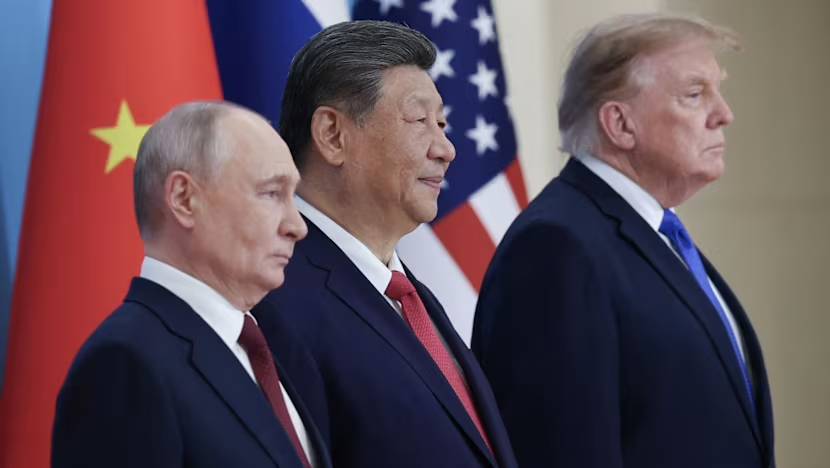
Leaders of China, the United States and Russia met on Thursday, Nov 19, on the sidelines of the Asia-Pacific Economic Cooperation summit in Shenzhen. Their 90-minute talks produced a joint declaration that pledges further talks on nuclear risks and cooperation on energy supplies and United Nations reform.
The declaration sets no timetable, mechanisms or plans for another meeting, according to the report.
According to the Chinese readout, the discussions covered the wars in Ukraine and the Middle East, the Korean Peninsula and nuclear proliferation.
Chong Ja Ian, an associate professor of political science at the National University of Singapore, told CNA that the three powers were "deciding for others, whether they like it or not."
Wang Dan, China director at Eurasia Group, called the summit "a diplomatic win for China." She said Trump gained a way to project himself as a powerful global leader to his domestic audience. She described Russia as the "biggest winner," saying its diplomatic status had been "elevated significantly."
Trump also held a 40-minute "pull-aside" with Putin, whom he greeted as his "friend," according to US officials. The report describes it as less than full bilateral talks.
The declaration said respect for the immunities of state officials was "of paramount importance" and that the International Criminal Court must not "abuse their jurisdiction." Putin is wanted by the ICC over the alleged unlawful deportation and transfer of children from occupied Ukraine to Russia.
At a news conference, Putin described the talks as "open" and "very useful" and said he wanted the format to continue. He said the leaders had reached "if not an agreement, then mutual understanding" on several areas.
The declaration reaffirmed that "a nuclear war cannot be won and must never be fought." It did not commit the three countries to arsenal cuts or formal three-way arms-control negotiations.
Wu Xinbo, dean of Fudan University's Institute of International Studies, said China expects the United States and Russia to make substantial nuclear reductions first. Daniel Salisbury of the International Institute for Strategic Studies called the commitment to nuclear talks "significant and positive."
According to the Stockholm International Peace Research Institute, China has about 620 nuclear warheads, compared with 5,042 held by the US and 5,420 by Russia.