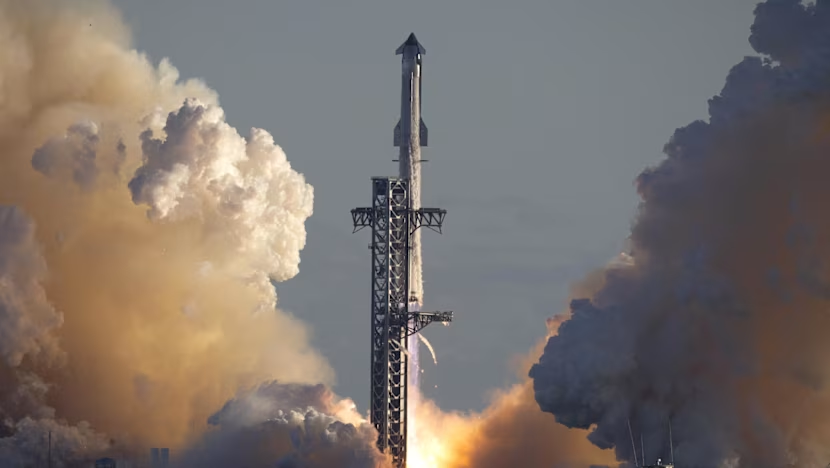
SpaceX's Starship spacecraft was "healthy" as it orbited the Earth on Friday, Nov 13, and was on track to return to its Texas launch site on Saturday, Nov 14, according to the source. The company planned to attempt a first-ever "catch" of the vehicle there.
This was the 15th test flight of Starship. The mission was originally designed to recover both the Super Heavy booster and the Starship spacecraft. That plan fell apart minutes after liftoff from Starbase in southern Texas.
An unspecified problem with the Super Heavy booster forced SpaceX to divert it to an "offshore splashdown." The booster fell into the Gulf of Mexico near the launch site, and a fireball erupted. SpaceX's Dan Huot said, "Not sure right now why we weren't able to bring it back."
The Starship spacecraft entered Earth's orbit and was expected to circle the globe 14 times before returning. SpaceX planned to recover it at around 3:20 p.m. Central time Saturday, which the source gives as 2120 GMT. SpaceX's Kate Tice said the company would only attempt the catch if the ship passed all system checks and decision gates. The source also says SpaceX has planned for scenarios in which it would shorten the flight and plunge the spacecraft into the Pacific Ocean.
While in space, Starship launched 26 satellites for Elon Musk's Starlink internet constellation.
Clayton Swope, an aerospace expert at the Center for Strategic and International Studies, called the mission a "mixed bag so far" after the booster catch failed. He said, "At least the Starship made it to orbit, like on the last test flight."